
BY EMOSI LASAQA-Mamanuca Environment Society
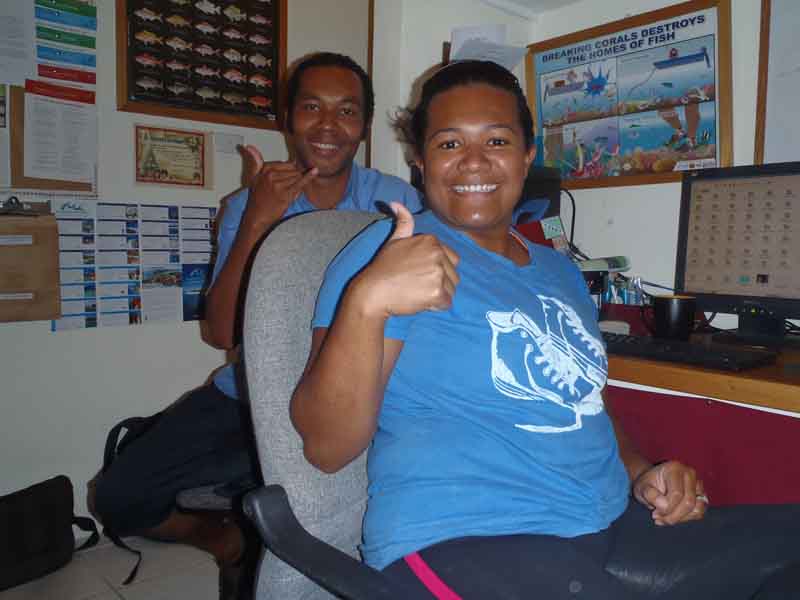
Mamanuca Environment Society field officers Diana Tora and Matereti Mateiwai share two special things in common.
They are both from Kadavu and have a soft spot for sea turtles.
The former’s first encounter with this gentle creature was at her mother’s village in Ogea, Lau when she was just 12 years old.
Mrs Tora has a degree in Marine Science, but she says it did not prepare her for the real-world challenges of turtle conservation.
She agreed that helping her ‘tauvus’ in the Mamanuca keep turtles out of their nets was not easy at first but the progress over the years was positive.
“Our villages now apply for permits through us and abide by the conditions set by Fisheries. They also alert us on illegal turtle harvesting and poaching of turtle eggs of any member of the village,” she said.
“I’ve encountered many turtles mainly hatchlings – too many to remember. After three years of the project I have observed an increase in turtle nesting in the Mamanucas and also a return of turtles into the area to either forage or nest.
“For example, Navini island resort when we just started the program told us that they can have one or two hawksbill nests every two years but this year they recorded seven nests and also witnessed two green turtles come up to nest.
“Beachcomber hasn’t had a turtle come up to nest in the past 10 years or so and this year they discovered two nests from hawksbills. Communities in Mana Island hadn’t seen any turtles nesting on their beach in a very long time until last year.
“Turtles return to their natal beaches (beach they were born) to nest. So it is very important to protect our nesting beaches by keeping development to a minimum or having turtle friendly beaches that help turtles come up to nest and not drive them away.
“They are an endangered species and Fiji is blessed to have five of the seven species in our waters. The hawksbill and green turtles are known to nest on our beaches and the other species swim through our waters to forage,” says Mrs Tora.
Matereti who started with MES this year, the journey has been very educating and exciting.
“Before joining MES, I only found out in the news how certain coastal villages would slaughter turtles by large numbers for their feasts (such as the case in Macuata in 2007 when they applied for a permit from fisheries and ended up killing 82 turtles).
“But, in the short amount of time spent at MES, I have witnessed how the issue of turtle conservation is treated differently, perhaps, we could say that the Mamanucas are just a few of the Islands who are actually sticking by the moratorium on turtles-even those who are caught or suspected of consuming turtles are taken to task, be it a lengthy procedure.
“In my recent trips up to Yanuya village, villagers would inform me on the number of turtles that they encounter on their fishing trips and their sizes. To hear villagers mention the increased sightings of turtles, one can tell that they are almost proud to be part of turtle conservation.
“For most of us, we all want to save sea turtles, because of their decline in numbers and that we want to conserve turtles so that the next generation can have the opportunity to witness them in the wild and not just read about turtles in books and how turtles disappeared or became extinct.
“In some cultures, turtles are associated with patience and longevity. Turtles have been around for about 200 million years-that in itself, is a good reason to conserve turtles,” the Nabouwalu, Ono native said.
Matereti said he has encountered about four juvenile-adults turtles for the last five months of field work.
“In April we were at Navini Island Resort conducting a shark count and it just happened that a turtle nest had just hatched and there was a little more than 80 hatchlings. Navini was special in the sense that in the previous two years there was not any sightings of turtle nests but this year while we were there, staff showed us seven nesting sites of Green and Hawksbill Turtles, one of which as mentioned earlier had just hatched.
“It was a great experience to come across those hatchlings it was my first time to dig up their nest and count up all the eggs that hatched or did not hatch.”
“Another encounter was at Castaway Island Resort while on a shark count snorkelling trip. A colleague spotted a Hawksbill Turtle and we followed it along the reef face to a popular dive site known as Southern Sisters -forgetting the shark count that we were suppose to do.
“There’s a moratorium is in place until 2018. There’s only six years left and already the amount of sightings we have been hearing about is positive,” Matereti says.

Hey, guys keep up the good work and I’m sure that the people that you got in touch with everyday do have a very good understanding of what you preached everyday on how we need to take care of our Marine Enviroment. I’m a big fan…keep going and never give up.
Bula Saki. Its only going to get better. Thank you so much for your hospitality to the MES staff. Until next time…stay environmentally aware.